



Using Simulators and Indoor Facilities: How Much Does It Improve Your Game?
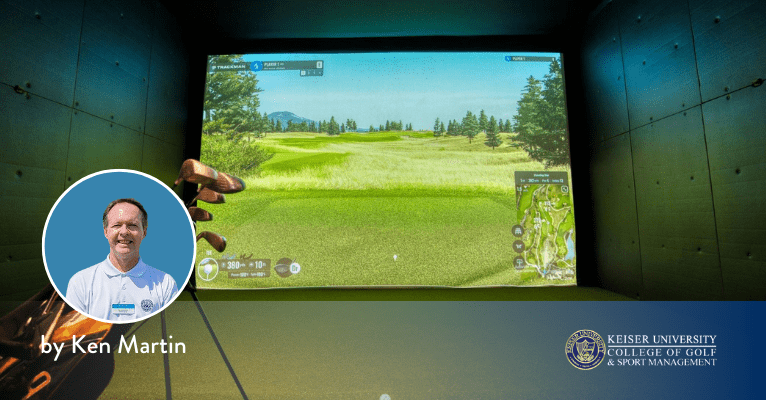
By Ken Martin, Keiser University College of Golf Professor – PGA Certified Professional
Golf is a game of precision, patience, and relentless practice. But let’s face it, Mother Nature doesn’t always cooperate. Rain, snow, darkness, or a packed schedule can derail your range sessions or course time. Enter golf simulators and indoor facilities: high-tech havens that promise year-round practice with launch monitors like TrackMan, FlightScope, or Foresight GCQuad, capturing every nuance of your club mechanics. These setups allow you to play virtual rounds on Pebble Beach or St. Andrews from the comfort of your garage or a local bay. But the million-dollar question follows.
What Are Golf Simulators and Indoor Facilities?
Golf simulators combine a hitting mat, high-speed cameras or radar, projectors/screens, and software to replicate courses and track metrics like ball speed, launch angle, spin, carry distance, and club path. Top units (e.g., TrackMan 4, Uneekor) boast sub-millimeter accuracy indoors.
Indoor facilities amp this up with climate-controlled bays, premium launch monitors, professional instruction, and social vibes. Places like X-Golf or local simulation centers offer hourly rentals ($40-60) or memberships, often with club fittings and golf swing lessons. Home setups range from a low of $5K (Garmin Approach R10) to $50K+ professional grade.
Unlike a driving range, simulators provide instant and objective feedback. There is no guessing yardage. Data tells you specifics, such as your 7-iron carries 162 yards with 6500 RPM backspin. This can turn practice into purposeful training.
How much do they improve your game?
The short answer? A lot, if used right. Anecdotal evidence from thousands of golfers shows that handicap drops of 4-10 strokes in the first year or two are common. National Golf Foundation data reveals simulator users are 29% more likely to play more real golf, not less, as the tech sharpens skills and builds confidence. This blog will unpack the benefits, quantify the gains, address limitations, and share strategies to maximize your improvement.
Data Quantifying Improvement
Formal studies are scarce, but real-world user reports paint a compelling picture. On Reddit’s r/Golfsimulator, a hub for 100K+ enthusiasts, threads like “Sim impact on handicap” reveal consistent gains, as shown in the table below:
| User Example | Pre-Sim Handicap | Post-Sim Handicap | Time Frame | Key Improvements |
|---|---|---|---|---|
| jcumb3r | 23 | 13 | 2.5 years | Ball striking, accessibility |
| tylerm99 | 9.4 | 6.1 | 11 months | Iron play, wedges |
| Anonymous | 12 | 2 | Unspecified | GIRs from 5 to 12 |
| SerendipityAffinity | 16 | 12 | 4 months | Consistency |
| hide_ur_kids | 16 | 9.3 | 6 months | Overall |
Averaging dozens of other self-reports reveals the following information: 5-7 stroke drops in 6-18 months for mid-handicappers (10-20 index); low handicappers (5-10) shave 2-4 strokes via speed gains and precision. On X (formerly Twitter), golfers echo this. One user dropped from 8.5 to 3.8 via a sim/range hybrid practice. Another shot 75 outdoors after 45 sim rounds. YouTube challenges (e.g., 8 Month Test) show 10+ stroke gains, with ball striking surging.
Why do these gains purportedly occur is a logical question. The answer may lie in a significant increase in the volume of repetition. A typical live driving range session yields 50-100 balls; sims enable 200-plus golf shots in an hour, focusing on specifics like 75% swings or 100-yard wedges.
Key Areas Where Sims Shine
Indoor golf simulators have transformed practice routines by offering data-driven insights and realistic course experiences. Beyond convenience, they provide measurable improvements across every facet of the game—from precision iron play to mastering partial wedge shots. By leveraging advanced metrics and immersive environments, players can refine technique, build confidence, and prepare for real-world performance under pressure.
Ball Striking and Irons
Sims excel here. Users report Greens In Regulation (GIR) doubling and dispersion tightening. Arccos data shows iron play distinguishes a separation in handicaps. Sims dial in carry distances and spins, which can significantly aid approach shot control.
Wedges and Short Game
Partial swings (50-75%) are game-changers. Practice flop shots, pitches from varied lies without digging divots.
Driver Speed and Distance
Metrics like attack angle optimize launch. Many add 5-10 MPH clubhead speed.
Putting (with caveats)
Some sims auto-putt; better ones (TrackMan) track stroke path/speed when paired with a putting green mat.
Mental Game
Play pressure-packed virtual rounds to simulate Sundays. During the offseason, professionals like Rory McIlroy swear by them because sims help maintain sharpness when courses are closed.
Conclusion: Your Game’s Best Friend
Golf simulators and indoor facilities can slash 5+ strokes off your handicap, especially relative to ball striking and consistency. They are not perfect; no tech can match on-course reality. However, they are transformative for practice volume and feedback. Commit 3-6 months to structured use, blend that with real play, and you will most likely watch scores plummet.