



Golf GPS Watches vs. Rangefinders: Which Is Right for Your Game?
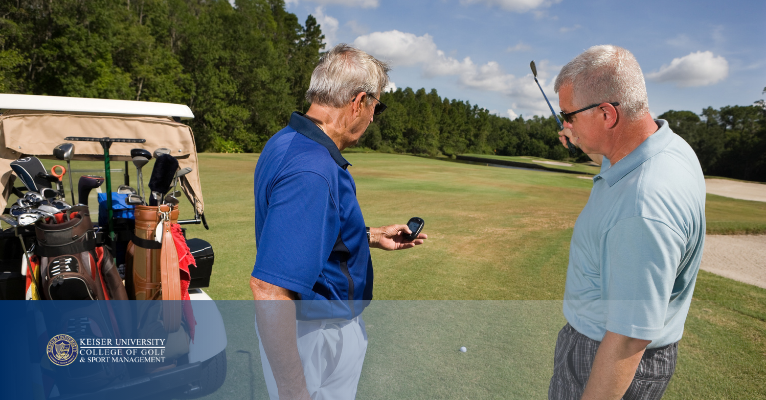
Today’s golfers rely on a wide range of accessories to elevate their game, including options to help measure the distance between their ball and another target (such as a flagstick). When it comes to measuring that distance with accuracy, many golfers leverage rangefinders, GPS watches, or a combination of both. So, what’s the difference — and how can you decide which option is right for you?
Why Accurate Distance Matters in Golf
Understanding the distance between your ball and your target on the golf course helps you make better-informed decisions about which club to shoot with and whether or not you’ll be able to clear hazards along the way. In this sense, accurate distance measurements could help you make more strategic decisions while improving your overall scoring and performance.
How a GPS Golf Watch Works
One of the most common accessories golfers use to measure distance is a GPS golf watch.
Key Features of GPS Golf Watches
A GPS golf watch looks similar to any other type of smart watch, but with added features for golfers that enable accurate distance measuring. Some common features of GPS golf watches on the market today include:
- Front/center/back yardages, or distances to different parts of the green based on GPS data.
- Hazard mapping, or real-time information on known course hazards, such as water and bunkers.
- Automatic hole recognition, or automatic switching to the next hole when the watch detects that a previous hole has been completed.
- Shot tracking, or the ability to automatically measure the distance and path of every shot taken.
- Fitness and smartwatch integration, or the ability to sync data with fitness apps or other wearable devices for a seamless experience.
Pros of GPS Golf Watches
Many golfers enjoy using GPS golf watches because they:
- Offer a hands-free and accessible experience.
- Provide quick yardages without needing to aim at a target.
- Are helpful for blind shots or doglegs where the flag isn’t visible.
- Can store performance data for analysis.
Cons of GPS Golf Watches
On the other hand, some drawbacks of GPS golf watches include:
- Yardage estimates that are not always exact to the pin.
- Potential for the battery to run out, especially during long rounds.
- The need for annual updates or (in some cases) paid subscriptions for course maps.
How a Laser Rangefinder Works
A rangefinder, in contrast, is a device that works by emitting a laser. When it is pointed at a target (such as a green), the laser beam bounces back to the player’s location — and the device automatically calculates the distance from the player to the chosen target.
Key Features of Golf Rangefinders
While not all rangefinders in golf offer the exact same specs, common features include:
- Pin-seeking mode, helping users zero in on flagsticks with ease.
- Slope adjustment, which automatically adjusts distances based on uphill and downhill slopes.
- High accuracy, which is achieved through precise laser measurement.
- Versatility, as rangefinders can be used not just in golf, but in other sports (like hunting and archery).
Pros of Golf Rangefinders
Many golfers enjoy using rangefinders due to their:
- Extreme accuracy to the flag.
- Ability to operate without reliance on preloaded course maps.
- Usefulness on unfamiliar or newly built courses.
- Lightweight construction and quick operation.
Cons of Golf Rangefinders
Of course, rangefinders aren’t perfect. A few potential drawbacks of using one include:
- The inability to measure blind shots.
- The need for very steady hands to lock on targets.
- Greater time investment than simply glancing at a watch.
- Limited additional features compared to GPS devices.
GPS Watch vs. Rangefinder: Side-by-Side Comparison
| Feature | GPS Watch | Rangefinder |
|---|---|---|
| Accuracy | Within 3–5 yards (general areas) | Within 1 yard (specific targets) |
| Speed of Use | Instant glance at the wrist | Must aim and measure each time |
| Hazard Awareness | Shows bunkers, water, and doglegs | Can’t see hazards that are not in line of sight |
| Course Coverage | Preloaded maps worldwide | Works anywhere with no maps required |
| Blind Shots | Provides distance even without a line of sight | Not useful without a visual target |
| Extra Features | Shot tracking, fitness, and smartwatch tools | Primarily distance only |
| Best For | Golfers who want convenience and strategy | Golfers who want precision to the pin |
Which Golfers Should Use a GPS Watch?
Generally, GPS watches are ideal for golfers who prefer a convenient, hands-free way to improve their distance control and make better-informed decisions on the course. These devices are also an excellent choice for golfers who want to explore additional features, such as automatic shot tracking and course mapping.
Which Golfers Should Use a Rangefinder?
A rangefinder may be preferred by more experienced athletes who need the most precise distance measurements at all times. Because using a rangefinder does require a steady hand and some practice/experience, it’s often the preferred option for professional golfers.
Should You Use Both a GPS Watch and a Rangefinder?
Both rangefinders and GPS watches come with inherent pros and cons. To get the best of both worlds, some golfers will use a GPS watch and a rangefinder. For example, a golfer may rely on a GPS watch for features like shot tracking and hazard mapping — while still breaking out the rangefinder for added precision when calculating distances to the target.
Cost Considerations
If cost is a deciding factor, it’s worth noting that rangefinders tend to be more affordable than GPS watches; however, pricing on both can vary drastically based on brand and features. It’s possible to find a decent rangefinder for less than $100, whereas many GPS watches will cost upwards of $200.
Tournament Rules: Rangefinder or GPS in Competition?
Keep in mind, too, that rangefinders and GPS watches may not be permitted in competitive play, as rules can vary considerably from one event to the next. Some tournaments, for instance, still require golfers to rely on caddies for distance and course information. Others may permit rangefinders and GPS devices, but only for basic features (like distance calculations).
Therefore, it’s important to review the rules for any tournament before you compete in order to avoid disqualification.
The Role of Technology in Golf Education
Golf tech is constantly evolving, leaving golf educators responsible for staying on top of the latest tools and incorporating them into their teaching. At Keiser University College of Golf, our educators take this responsibility seriously — ensuring that our programs are always up to date and aligned with the latest innovations so we can prepare students for industry success.
Tips for Choosing Between a GPS Watch and a Rangefinder
Still trying to decide between a GPS watch and a rangefinder? Start by weighing your priorities: Are you focused on precision in distance measurements, or are you more interested in convenience and features?
In addition, consider your budget as you explore your options. If cost is a concern, you might start out with an inexpensive rangefinder and only look into upgrading as you gain more experience on the course.
Certain brands may even offer you the option to try a device before you buy it, so take advantage. After testing out a few different rangefinders and/or GPS devices, you may have an easier time deciding which is best for you, your budget, and your long-term goals.
Final Verdict: GPS Watch vs. Rangefinder in Golf
When it comes to precision, rangefinders really can’t be beat. But when you’re looking for additional features and a hands-free experience, a GPS watch can be a great accessory for many golfers. If you’re still not sure which option best suits you, consider doing what many golfers do and using a combination of both (if your budget allows).
Best GPS Watches and Rangefinders for Golfers in 2025
Looking for some recommendations as you shop for the best golf rangefinders and GPS devices? These hand-picked options may be worth a look:
Top Golf GPS Watches in 2025
- Garmin Approach S70– Features a virtual caddie, preloaded course maps, and a bright display for easy viewing (even on sunny days).
- Bushnell iON Elite– Offers patented slope-compensation technology, more than 38,000 preloaded course maps, and a battery life of more than 12 hours.
- Shot Scope X5- Features automatic shot recording, post-round analytics, and a convenient digital scorecard.
- SkyCaddie LX5C- Offers the largest available touchscreen at 1.39″ as well as more than 35,000 error-corrected maps and easy zoom/panning for added precision.
Top Golf Rangefinders in 2025
- Bushnell Pro X3+- Features a convenient dual display, built-in wind speed detection, and up to 7x magnification for easy viewing.
- Nikon Coolshot ProII Stabilized- Offers optical image stabilization, slope-adjusted distance measurements, and a bright OLED display screen.
- Blue Tees Series 3 Max– Features a built-in magnetic strip for easy attachment, a 900-yard range, and a 4K display for easy readability.
- Garmin Approach Z82– Provides accuracy within 10 inches, a convenient flag finder tool, and tournament mode to easily disable non-permitted features.
Golf GPS Watches vs. Rangefinders FAQs
Is a rangefinder in golf more accurate than a GPS watch?
Typically, yes. A quality rangefinder uses laser technology to pinpoint targets on the course — usually to an accuracy of within 1 yard. GPS watches, on the other hand, don’t tend to be quite as accurate.
Can I use a rangefinder or GPS in tournaments?
This can vary greatly from one tournament to the next. As a general rule, most golf tournaments do allow the use of rangefinders and GPS devices, with the caveat that certain features must be disabled (such as wind speed and club recommendations). In other words, these devices should be used for distance measurements only.
Do professional golfers use GPS or rangefinders?
Rules regarding the use of GPS devices and rangefinders by professional golfers may depend on the event. For practice rounds, these devices are always permitted. During official competitions, however, different rules may apply. For example, many LIV Golf events do allow rangefinders — but the PGA Tour still restricts their use.
Which is better for beginners: GPS watch vs rangefinder?
There’s no universal answer to which option is better, because no two golfers have the exact same preferences. In general, though, a GPS watch will be the more convenient and user-friendly option for a beginner golfer. However, with more experience, a rangefinder may be better from an accuracy standpoint.
Can I use both a GPS watch and a rangefinder?
Provided that you’re not competing in an event where either device is prohibited, you can leverage both a GPS watch and a rangefinder while golfing. In fact, many golfers find that these devices complement each other well, with rangefinders offering excellent accuracy and GPS watches proving valuable in blind spots.
Take Your Golf Education to the Next Level
The right accessories, like GPS watches and rangefinders, can give your golf game a boost and help you become more competitive. At the same time, technology can only take you so far. If you’re looking to build a more solid foundation in golf, explore what we have to offer at Keiser University College of Golf.
Degrees at both the undergraduate and graduate levels are designed to suit your needs, including our popular Bachelor of Science in Golf Management and Master of Science in Golf Teaching and Learning. Contact our team to request more information about these programs, or get started on your application today.
Sources
https://collegeofgolf.keiseruniversity.edu/programs/golf-teaching-and-learning-ms/
https://imaging.nikon.com/sport-optics/lineup/laser/coolshot_proii_stabilized/
https://www.tgw.com/golf-guide/5-reasons-you-need-a-rangefinder/
https://www.worldwidegolfshops.com/insider/post/time-to-elevate-your-game-with-gps-golf-watches
https://blog.golfnow.com/how-to-use-golf-rangefinder/
https://yesgolfing.com/en/opinion-polls/should-rangefinders-be-allowed-on-the-pga-tour/74
https://www.golfmonthly.com/tour/are-rangefinders-allowed-in-pro-golf
https://www.golfmonthly.com/reviews/laser/best-budget-golf-rangefinders-year
https://shotscope.com/blog/practice-green/features/why-do-you-need-a-golf-gps-watch/
https://practical-golf.com/why-rangefinders-arent-for-everybody
https://www.garmin.com/en-US/p/672620/
https://blueteesgolf.com/products/series-3-max-golf-rangefinder-with-slope
https://collegeofgolf.keiseruniversity.edu/programs/bachelor-science-golf-management/
https://enroll.enrolledu.net/rfi-profile-flagship
https://www.garmin.com/en-US/p/847706/
https://bushnellgolfsa.co.za/product/ion-elite-white/